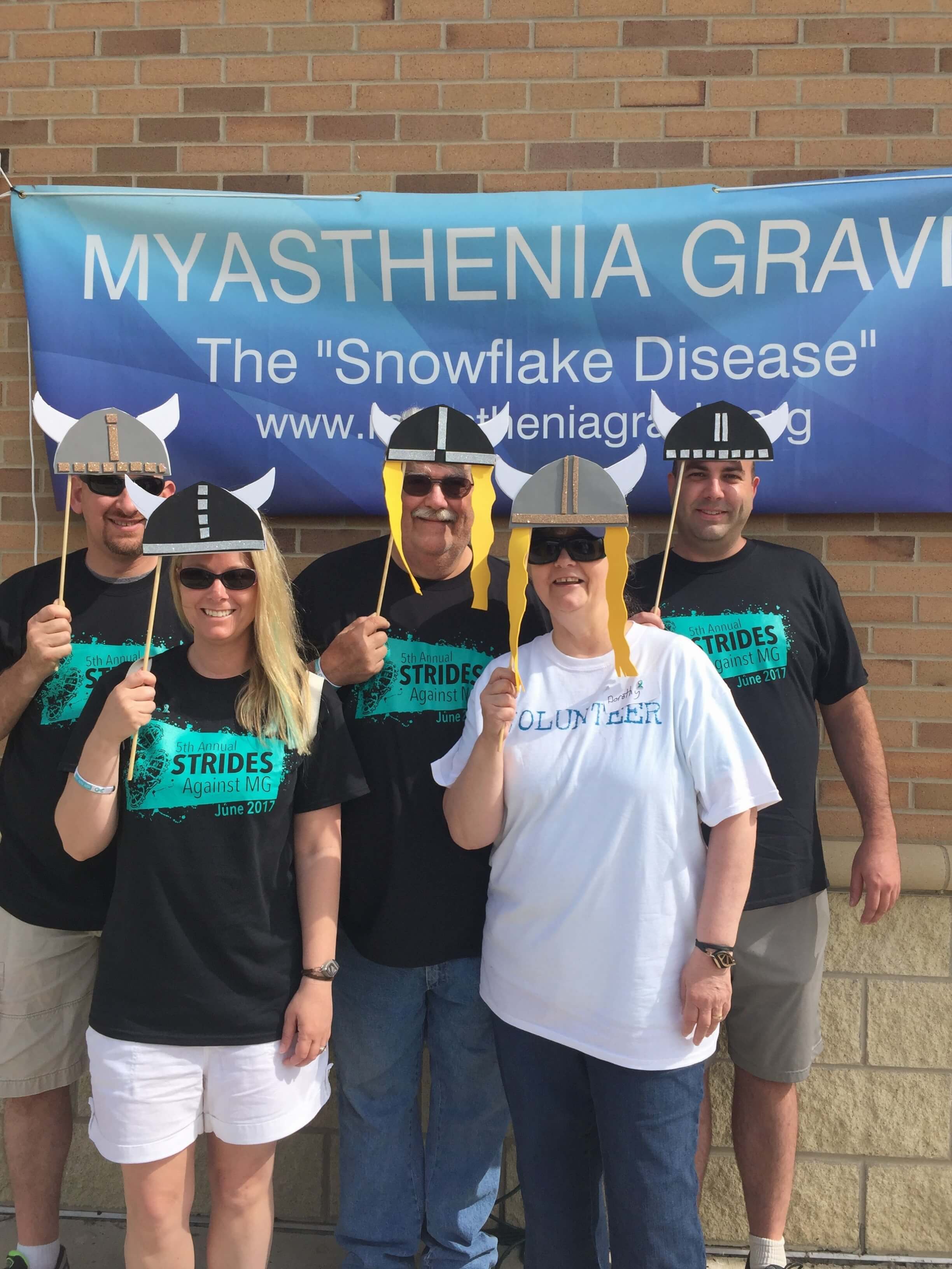
Get ready for a family-friendly celebration with bubbles and hula hoops as we walk side by side to show our support for those affected by myasthenia gravis.
ABOUT THE WALK
Family-Friendly Walk & Kids’ Dash
Sunday, June 4, 2017
Registration begins at 8:00 a.m.
Announcements begin at 8:30 a.m.
Kids Dash begins at 8:45 a.m.
Walk begins at 9:00 a.m.
This is an untimed walk. Add to the fun with your own creative accessories and team signs!
WHERE
Berens Park, 493 Oaklawn Avenue
Elmhurst, IL 60126
REGISTRATION FEE
$30 per person
$35 on walk day
$10 per child under age 12
REGISTER BY MAY 9 to ensure you get a t-shirt and that it’s the right size. Youth Medium and Men’s sizes up to 3X available. If you need a different size, register and call us before May 9.
When you register online, you can electronically sign an event waiver for yourself. Waiver signatures for anyone else you sign up will be gathered at the event.
To register by mail, click here to print a 2017walkform.
Mail or drop off a check to our office by Friday, February 10. Make it payable to Conquer MG, 275 N. York St., Suite 401, Elmhurst IL 60126.
Pay at the door with cash, check, or credit card.
Q: Is any part of the registration fee tax-deductible?
A: Event proceeds support Conquer Myasthenia Gravis, a 501(c)(3) nonprofit. $15 of every $20 registration fee is tax deductible to the full extent of the law.
Q: Will the bar be open during the game?
A: Of course! You can support the Elmhurst American Legion with your purchase of beer ($1.75) and mixed drinks ($4.00).
Q: Your flyer says to bring snacks?
A: No food is sold at the bar (nada – we mean it). So feel free to bring your own! Chips, dip, fruit plates, whatever! (Just leave the crockpots at home.)
Q: Did you say “prizes”?
A: Door prizes between rounds! You’ll have 8 chances to win. A trophy and prize for the winning team, bragging rights for the teams who come in 2nd and 3rd, medals for the best team name (be creative!), and the judge’s decisions are final.
Q: What’s the parking situation?
A: Plentiful and free.
Q: What is myasthenia gravis?
A: Myasthenia gravis is a rare autoimmune disease that disrupts the communication between nerve and muscles, causing sometimes severe muscle weakness. It can affect the eyes and facial muscles; swallowing and talking; limbs, neck and torso; and even breathing muscles. There are treatments, but no cure.
Q: Who is Conquer Myasthenia Gravis?
A: Formerly known as the Myasthenia Gravis Foundation of Illinois, Conquer MG has served people who struggle with this challenging disease since 1976 – with programs of support, education, awareness, and research funding.
Myasthenia Gravis & Drug Interactions
Posted by myasthenia
If you have myasthenia gravis, it’s not unusual to be taking multiple medications. How do those drugs interact with drugs for infection, pain, or other illnesses, or with the over-the-counter (OTC) medications and supplements that can be found in most people’s medicine chests?
The topic of “Myasthenia Gravis and Drug Interactions” was addressed at Conquer MG’s October 2016 patient seminar in Oak Lawn, Illinois. Our speaker was Mitra Habibi, PharmD, from the University of Illinois at Chicago College of Pharmacy. Doctor Habibi is a clinical pharmacist; she works with physicians to coordinate care and medications for patients in the hospital setting. She also teaches at the University.
Here are highlights from Dr. Habibi’s presentation.
General Cautions
Avoid combining your meds in an old pill bottle; the label will be inaccurate and confusing for others.
Always keep an up-to-date list of your medications and doses in your wallet. That way you can share consistent and complete information with all of your health care providers.
To avoid drug interaction problems, it’s essential that each of your doctors has an accurate picture of all medications you’re taking, including over-the-counter (OTC) meds and herbal supplements.
OTC meds and supplements are drugs and can trigger interactions with other medications you take.
As we age, our bodies – including the liver and kidneys – metabolize drugs differently. So doses need to change.
Medications that Can Worsen MG Weakness
Antibiotics are the biggest classification of drugs that potentially cause problems in patients with MG. There are classes of antibiotics that can be used for MG patients and classes that should not be used. Key: your prescribing doctor should be aware that you have MG.
Never use someone else’s leftover antibiotics (even if you think you have the same illness), because you may be unaware of adverse effects with your MG or your other medications.
Medications labeled with black box warnings related to myasthenia gravis should be avoided. The Food and Drug Administration (FDA) requires this strictest warning when there is significant risk of serious or life-threatening side effects. The warning is surrounded by a black outline on the prescription container and insert.
These antibiotics have black box warnings and should not be used for individuals with myasthenia gravis:
Tobramycin – probably the weakest neuromuscular blocking effect (least problematic)
Macrolies (erythromycin, zithromycin or z-pack) – use cautiously, if at all
Clindamycin – Likely to worsen MG
These antibiotics have not been shown to cause many problems for MG patients
Tetracycline (doxycycline, minocycline) – this may worsen MG
Sulfonamides (Bactrim), Penicillin – causes rare cases, usually not a problem for majority of MG patients
Voriconazole (antifungual) and peramivir (antiviral) reported to worsen MG
Botulinum toxin (Botox) – avoid use
Other Topics
Dr. Habibi also noted:
Magnesium can interfere with neuromuscular transmission. The usual doses of medications containing magnesium (antacids, laxatives) are unlikely to cause problems – except in patients with kidney disease. The amount of magnesium in daily multivitamins is unlikely to cause problems. However, intravenous doses of magnesium sulfate can cause serious muscle weakness and should be avoided in MG patients.
The effect of Beta blockers on myasthenia gravis depends on the dose and type of medication. Propranolol is the most likely offender to cause fatigue, while Atenolol is least likely.
Steroids, commonly used to treat MG weakness, can have many adverse effects.
With pain management, it’s important to consider the individual to minimize drug interactions. Your doctor should take into account the severity of your MG disease, other complicating illnesses, and other medications being used before recommending pain meds. In general, aspirin, non-steroidal anti-inflammatory drugs (NSAIDs) such as ibuprofen and naproxen, and acetaminophen (Tylenol) are considered safe for MG, that is, they have not been shown to worsen MG or cause muscle weakness. However, each of these medications carry risks (for example, NSAIDS can increase the risk of stomach ulcers when taken with steroids), so it’s important to view the individual situation.